BUILT AN AUTONOMOUS B2B SALES AGENT IN 6 HOURS - AGENTATHON 2026
How I built HuntR - a 5-agent autonomous B2B client acquisition system using Google ADK and Gemini 2.5 - from blank repo to production deployment in under 6 hours, for Agentathon 2026.
The Problem I Set Out to Solve
Most Indian startups lose deals not because their product is bad - but because their outreach is generic, late, and manual.
A junior sales rep spends 3–4 hours daily on prospecting. ₹840+ per lead in time. 80% of cold emails get ignored because they're not personalized.
I wanted to build something that eliminated this entirely. Not a template tool. An autonomous system that actually thinks.
What is HuntR?
HuntR is a multi-agent AI system that autonomously finds, researches, scores, and personally messages your next B2B client - in under 2 minutes.
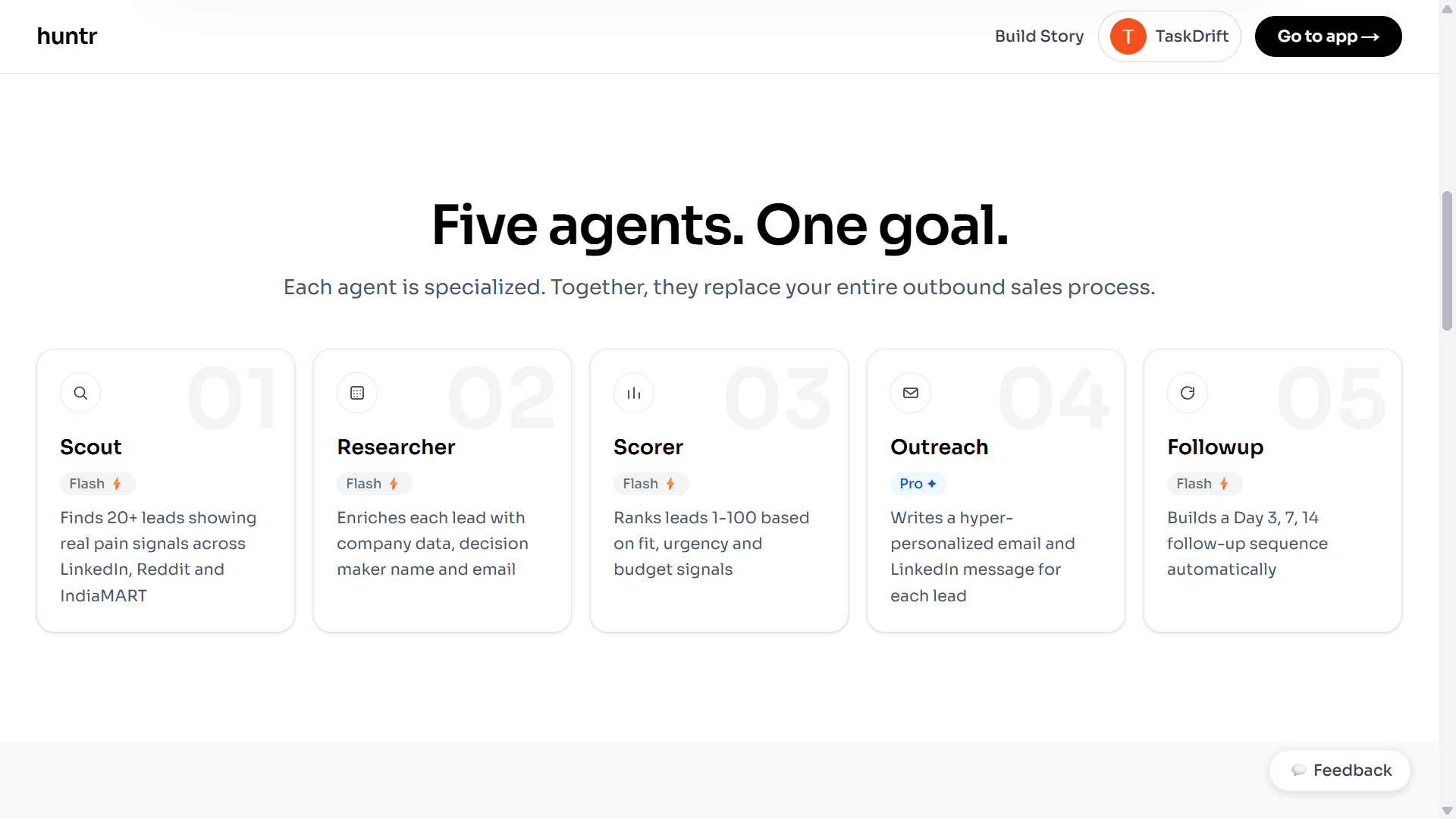
Five specialized agents work in sequence:
- Scout Agent - Finds 20+ leads showing real pain signals across LinkedIn, Reddit, and IndiaMART
- Researcher Agent - Enriches each lead with company data, decision maker name, title, and email
- Scorer Agent - Ranks leads 1–100 using India-specific signals: company size, startup age, pain signal strength, decision maker reachability
- Outreach Agent - Writes a hyper-personalized cold email and LinkedIn message per lead using Gemini 2.5 Pro
- Followup Agent - Builds a Day 3, 7, 14 follow-up sequence automatically
The whole pipeline runs in under 3 minutes. Every message is unique. Zero human intervention required.
Live: huntr.mohanprasath.dev
GitHub: github.com/mohanprasath-dev/huntr
The Build
This was built for Agentathon 2026 - NxtWave NIAT's national-level AI agent hackathon.
Hour 1 - Core Agent Pipeline
Set up the project structure with Google ADK for orchestration. Built the first three agents - Scout, Researcher, Scorer - connected Serper and Tavily APIs for real-time web intelligence. First end-to-end lead generated in terminal within the first hour.
Hour 2 - Intelligence + API
Added the Manager Agent with self-correction logic - if Scout returns fewer than 5 leads, the Manager automatically retries with 3 refined query variations. Built FastAPI backend with SSE streaming for real-time agent trace. Connected Brevo SMTP for email delivery.
Hour 3 - Dashboard + Deploy
Built the Next.js dashboard with a live agent pipeline visualization that shows each agent activating in real time. Deployed backend to Cloud Run, frontend to Vercel. First production hunt completed.
Hours 3–6 - Intelligence Upgrades
Upgraded Scout with India-specific query strategies - 5 targeted queries per hunt, domain-based deduplication, content site filtering. Added Firestore persistence, CSV export, email open tracking via pixel, voice input, campaign comparison, Google OAuth, and a full light theme redesign.
Key Technical Decisions
Dual-Model Strategy
I used two Gemini models deliberately:
- Gemini 2.5 Pro - Manager Agent and Outreach Agent, where reasoning quality and personalization depth matter most
- Gemini 2.5 Flash - Scout, Researcher, Scorer, Followup, where speed is the priority
This gave me the best output quality where it was visible to users, while keeping pipeline speed fast everywhere else.
Why Google ADK over CrewAI
Google ADK was taught directly in our NIAT curriculum and integrates natively with Vertex AI - no additional configuration, no cost overhead. More importantly, it gave me fine-grained control over agent orchestration that higher-level frameworks abstract away.
Why SSE over WebSockets
Server-Sent Events are unidirectional, simpler to implement, and perfectly suited for streaming agent trace events from backend to frontend. No connection management overhead. Works out of the box with FastAPI and Next.js.
Self-Correction Architecture
The Manager Agent checks lead count after every Scout attempt. If below threshold, it generates 3 query variations - broader niche terms, different pain signal angles, alternate platforms - and merges unique results. If Scorer returns zero qualified leads, threshold drops from 60 to 50 and rescores. Every failure has a defined recovery path.
What It Feels Like to Use
You type your niche and pain keyword. One click. Then you watch:
- Scout activates - leads start appearing
- Self-correction triggers if needed - yellow banner, then green
- Researcher enriches each lead in real time
- Scorer ranks the top candidates
- Outreach writes emails that reference the company's exact situation
- Followup sequences the next two weeks
Impact bar shows: 3 hours saved, ₹4,200 in manual effort replaced, pipeline completed in 163 seconds.
You click Approve & Send. The email goes. Pixel tracking fires when they open it. "🎉 Email opened."
That's the whole product.
Results
- 57 leads found in a single test hunt
- 163 seconds average pipeline time
- 5 agents, 0 human intervention
- Built and deployed solo in under 6 hours
What This Built In Me
- Designing for real-world failure modes - every agent has a recovery path
- Choosing the right model for the right job - not defaulting to the most powerful option everywhere
- Building for demo impact without sacrificing engineering depth
- Shipping fast without cutting corners on architecture
Closing
The best hackathon projects solve a problem you've personally felt.
Every founder I know has spent hours on LinkedIn, crafting emails that get ignored. HuntR doesn't just automate that - it makes the outreach genuinely personal, at scale, autonomously.
That's the only kind of automation worth building.